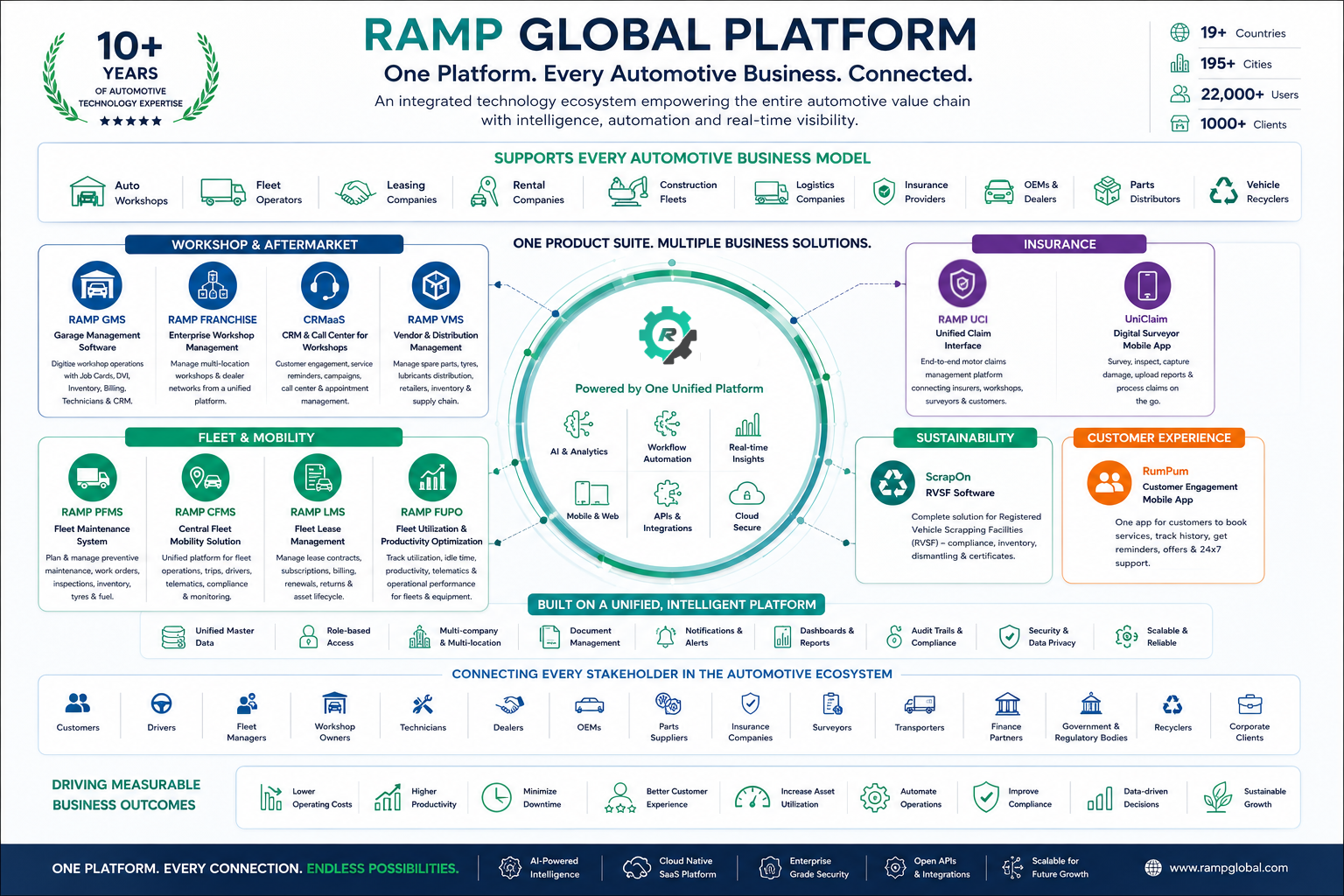
RAMP – FLEET OPERATIONS
You Are Not Losing Money
in Fleet Operations
Where You Think You Are
The real losses don’t sit in fuel bills, maintenance costs, or utilization reports. They exist in the gaps between teams, decisions, and time—where no one has full visibility or ownership.
The Reality Inside Fleet-Dependent Organizations
Idle Assets
Underutilized vehicles without visibility
Reactive Maintenance
Breakdowns drive maintenance activity
Invisible Downtime
Lost operating hours go unrecorded
Fuel After the Fact
Analysis without real control
Incident-Led Safety
Action taken only after events
Audit-Time Compliance
Gaps discovered too late
This does not happen due to negligence.
It happens because fleet operations is structurally different from other business functions.
Organizations that recognize this treat fleet as a strategic discipline.
Those that don’t reduce it to a cost center — and lose ground quietly over time.
Fleet Operations Faces Three Pressures No Other Business Function Does
Capital Intensity
Fleet represents a massive controllable asset class, yet it often receives much less operational scrutiny than direct labor or material costs at scale.
Non-Linear Complexity
Operational complexity grows exponentially with fleet size. Intuition-based management works for small fleets but fails silently as organizations scale up.
Fragmented Accountability
Multiple internal teams share responsibility for the same assets, leading to disjointed workflows, fragmented data, and eroded operational ownership at scale.
Fleet Operations Is Not Monolithic
Different fleet segments operate under fundamentally different economic, regulatory, and operational constraints. Treating them as one category guarantees inefficiency.
Commercial & Enterprise Fleets
- Multi-location operations
- Long asset lifecycles
- Uptime and consistency driven
Leasing & Corporate Mobility Fleets
- Portfolio-level economics
- Residual value risk
- Lifecycle discipline critical
Last-Mile & Logistics Fleets
- Daily demand volatility
- Thin margins
- Capacity matching challenges
Government & Institutional Fleets
- Audit-first operations
- Budget rigidity
- Public accountability
Specialized & Equipment Fleets
- High capital per asset
- Specialized usage patterns
- Allocation precision required
No One Owns Fleet Performance — Everyone Optimizes Locally
- Operations optimize schedules.
- Maintenance optimizes repairs.
- Procurement optimize acquisition cost.
- Finance optimizes budgets.
- Compliance optimizes documentation.
Each function performs well individually—yet system-wide outcomes degrade.
Fleet operations fail not due to lack of effort, but due to lack of ownership.
Why Most Fleets Are Structurally Over-Capitalized
Most fleets are designed for peak demand, not average demand. Reliability buffers, asset specialization, geographic dispersion, and regulatory reserve requirements embed excess capacity into fleet design.
Key Insight
Low utilization is not accidental.
It is embedded in how fleets are designed.
Purpose-Built for Fleet-Dependent Organizations
Most fleet software tracks assets and GPS.
RAMP governs the entire fleet operational lifecycle.
RAMP functions as an operations intelligence layer, transforming raw vehicle data and workflows into a unified discipline—enabling consistent control over uptime, costs, and accountability across distributed enterprise environments.
Designed for organizations where

Maximize Uptime
Operational availability and breakdown management directly impact business throughput.

Control TCO
Daily operating costs and lifecycle expenses require centralized visibility and control.

Eliminate Leakage
Fuel usage, part replacements, and vendor management drive hidden operational losses.

Enforce Governance
Multiple teams, workshops, and vendors share operational responsibility for the fleet.
Designed to unify—not just monitor—fleet operations
What Operational Control Actually Looks Like
Operational control in fleet environments is not about tracking more data. It is about establishing decision authority over outcomes—across utilization, cost, uptime, and accountability.
Organizations that operate fleets as a discipline exhibit a fundamentally different operating model:
| Operational Dimension | Conventional Fleet Behavior | Controlled Fleet Operations |
|---|---|---|
| Asset Utilization | Visibility limited to location | Measured against demand, capacity, and deployment efficiency |
| Maintenance | Reactive, event-driven | Planned, lifecycle-aligned, downtime-aware |
| Fuel Management | Historical reporting | Continuous monitoring with behavioral control |
| Cost Management | Budget-based tracking | Asset-level lifecycle cost visibility |
| Accountability | Distributed across teams | Clearly defined ownership across lifecycle stages |
| Decision-Making | Delayed, fragmented | Integrated, cross-functional |
This is not a technology shift. It is a shift in how fleet operations are governed as a business function.
The Shift From Management to Governance
Fleet operations in most organizations are managed. Very few are governed.
Management focuses on
- Tasks
- Activities
- Execution
Governance focuses on
- Outcomes
- Accountability
- System-wide performance
Why Traditional Fleet KPIs Fail at Scale
Most fleet KPIs were designed for individual asset visibility, not orchestration of an enterprise system.
Activity Monitoring
Organizations don't fail due to lack of metrics, but due to lack of control mechanisms over what those metrics reveal.
Fleet Operations Is Becoming a Strategic Function
As asset intensity increases and digital transparency matures, fleet management is evolving from a support task into a core profitability lever.
Support Function
Strategic Lever
Cost Center
Value Driver
Operational Need
Competitive Advantage
The Disciplined Enterprise
The Legacy Enterprise
Ready to Orchestrate Your Fleet Operations at Scale?
Connect distributed assets, maintenance partners, and compliance workflows into a single, profit-driven fleet ecosystem.
Explore the RAMP Fleet Infrastructure Today
One Ecosystem. One Network. One Way of Operating.