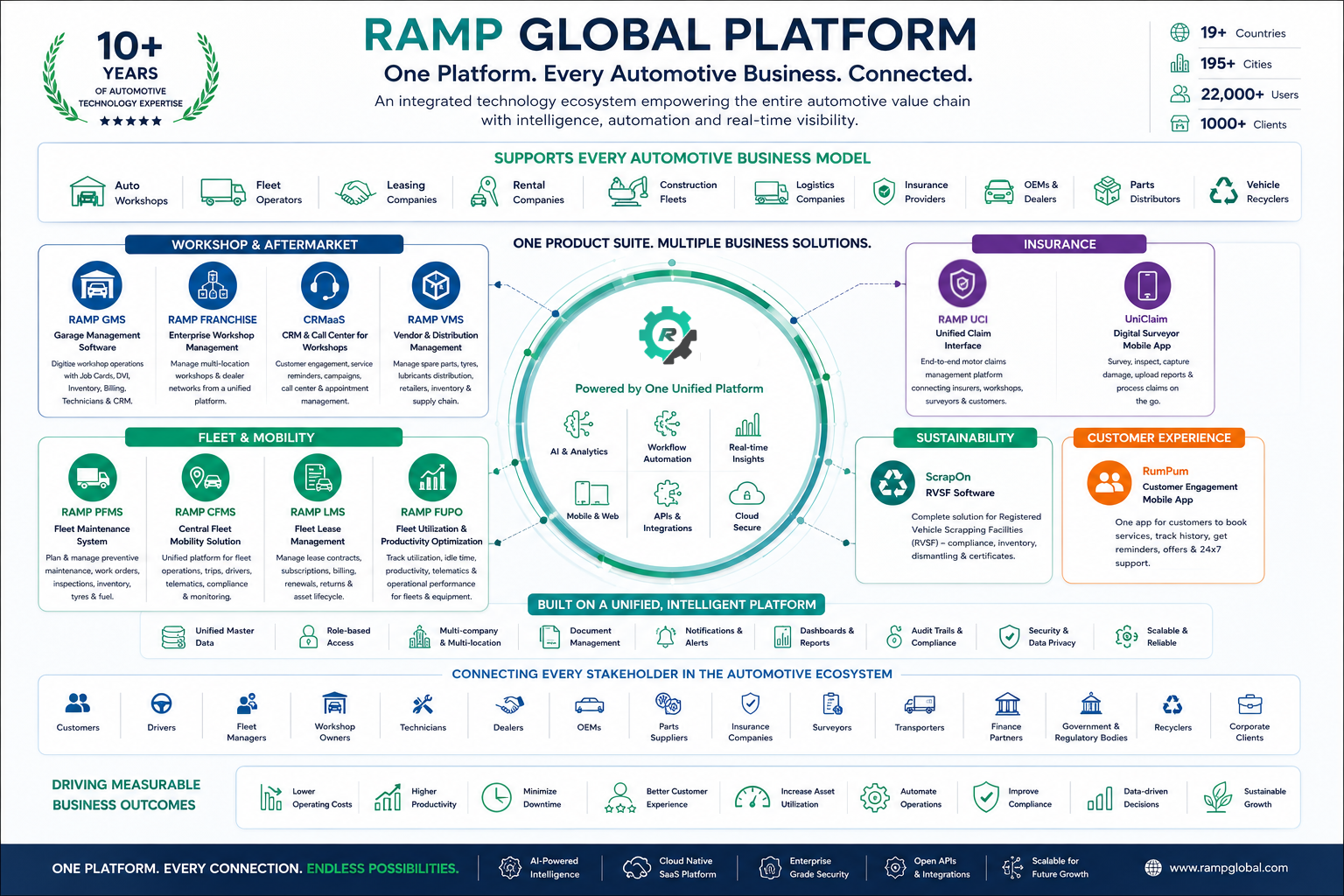
FLEET & MOBILITY
Keep Every Vehicle Ready.
Keep Every Operation Moving.
From owned fleets and vehicle leasing to rental and trip-based operations, RAMP connects fleet assets, drivers, operations, maintenance, compliance and financial workflows through one connected operating ecosystem.
Vehicle Readiness & Deployment
Driver & Duty Allocation
Preventive Maintenance & PMs
Trip, Route & Utilization
Compliance & Safety Control
Unified TCO & Cost Control
Managing a Fleet Is More Than Keeping Vehicles on the Road.
Fleet performance depends on a connected chain of decisions - which vehicles are available, where they are deployed, who operates them, how they are maintained, what they cost and whether they are being used effectively.
Fleet Availability
The right vehicle needs to be ready when operations require it.
Utilization
Vehicles can be available without being effectively utilized.
Maintenance & Downtime
Service delays and breakdowns directly affect operational continuity.
Cost Control
Fuel, maintenance, insurance, depreciation, rentals and operating costs accumulate across the fleet.
Compliance & Risk
Documents, inspections, permits and regulatory requirements need continuous attention.
Operational Coordination
Drivers, vehicles, locations, workshops, vendors and operations teams need to work from consistent information.
Every Fleet Connects People, Vehicles and Operations.
A fleet is not just physical hardware - it is a continuous operating loop connecting multiple specialized teams, field personnel and external commercial partners.
Fleet / Asset Team
Asset control & lifecycleOperations Team
Daily dispatch & executionDrivers & Operators
Vehicle execution & logsMaintenance / Workshop
Readiness & repair workflowsFLEET
BUSINESS
CENTRAL OPERATING CORE
Finance & Commercial
TCO, revenue & settlementsCustomers / Business Units
Demand & SLA complianceVendors & Partners
Parts, towing & servicesLeasing / Rental Partners
Contract & asset deploymentAsset Lifecycle
Fleet & Asset TeamsMaintains centralized visibility over asset status, inventory health, depreciation and strategic allocation across business requirements.
Dispatch & Routes
Operations TeamsOrchestrates daily operational demands, real-time vehicle assignments, driver pairing, SLA adherence and route fulfilment.
Field Operations
Drivers & OperatorsExecutes digital pre-trip checklists, logs ongoing trips, records fuel and incident reports, and performs clean handover protocols.
Workshop & Repairs
Maintenance TeamsCoordinates preventive maintenance, garage job cards, spare parts supply, breakdown recovery and rapid return to operational readiness.
Commercial & TCO
Finance & Commercial TeamsTracks lease billing, per-vehicle operating margins, fuel spend reconciliation, insurance claims recovery and total cost of ownership.
External Network
Vendors & PartnersConnects third-party garages, parts suppliers, RSA providers and tire vendors through digital work authorizations and billing.
One Fleet Ecosystem. Different Ways to Operate.
“Fleet” does not mean one single business model. RAMP supports and unifies diverse operating structures across corporate, commercial and mobility businesses.
Owned & Internal Fleet
For organizations operating vehicles for their own business operations.
- Corporate fleets
- Logistics operations
- Service fleets
- Institutional fleets
- Government / enterprise fleets
Vehicle Leasing
For businesses where vehicles are deployed under long-term lease arrangements.
- Operating leases
- Corporate lease programs
- Maintenance contracts
- Buyback & residual terms
Vehicle Rental
For short-term or usage-based vehicle deployment.
- Daily / weekly rentals
- Subscription mobility
- On-demand fleets
- Airport / city hubs
Trip-Based Fleet Operations
For businesses where vehicle utilization is driven by individual trips or assignments.
- Passenger transport
- Freight haulage runs
- Field service calls
- Dedicated driver dispatch
From Vehicle Demand to Lifecycle Decisions.
A connected fleet operation links upfront requirement planning with live deployment, health governance, cost accountability and residual asset value.
Demand
What vehicle or capacity is required?
Availability
Which vehicles are ready and available?
Allocation
Which vehicle and driver should be assigned?
Deployment
Where and for what purpose is the vehicle deployed?
Operation
How is the vehicle being used?
Maintenance & Compliance
Is it safe, compliant and maintained?
Cost & Performance
What is it costing and how effectively is it being used?
Renewal / Replacement
Should it continue operating, be redeployed, renewed or replaced?
Fleet management becomes more powerful when every operational decision is connected to the vehicle lifecycle.
Connect the Operations Behind Every Vehicle.
RAMP provides digital capabilities across fleet asset management, dispatch, maintenance, compliance, utilization and commercial governance - allowing organizations to orchestrate the operating model that fits their business.
Fleet & Asset Control
Asset status, inventory health, vehicle specs, ownership and lifecycle tracking.
Allocation & Dispatch
Match vehicles and drivers with demand, route dispatch, SLA adherence and duty logs.
Maintenance & Uptime
Plan preventive maintenance, garage job cards, breakdown recovery and parts readiness.
Compliance & Readiness
Digital pre-trip inspections, driver duty logs, statutory permits and document expiries.
Fuel & Utilization
Understand how vehicles are being used, idle hours, fuel spend reconciliation and per-km costs.
Commercial & TCO
Lease billing, per-vehicle operating margins, cost of ownership and lifecycle decisions.
The Capabilities Behind a
Connected Fleet Ecosystem.
Combine the RAMP products and enterprise solutions relevant to your operating model, from fleet orchestration and maintenance to leasing, workshop execution and vendor control.
CFMS
Fleet Mobility
& Orchestration
PFMS
Fleet Maintenance
& PM Workflows
LMS
Vehicle Leasing
& Asset Contracts
FLEET &
MOBILITY
Centralized governance, operational orchestration & multi-branch fleet execution.
Build a More Connected,
Predictable Fleet Operation.
Fleet
Availability
Keep the right vehicles ready and deployed where operational demand requires them.
Better
Utilization
Understand where fleet capacity is being used, underused, idle or unavailable in real time.
Maintenance
Control
Move from reactive breakdowns toward scheduled PMs, parts availability and controlled uptime.
Cost & Fuel
Visibility
Connect fuel spending, trip mileage, repairs, depreciation and per-kilometer economics.
Operational
Accountability
Create full visibility across drivers, duty logs, branch locations, service vendors and fleet managers.
Smarter
Lifecycle Decisions
Use unified total cost of ownership and asset health data to guide lease renewals and replacement timing.
Everything You Need to Know
About Fleet & Mobility Operations
Explore how modern fleet organizations connect assets, maintenance, drivers, and operations across diverse commercial workflows.
01. What types of fleet businesses can use RAMP?
RAMP can support organizations operating owned, leased, rental and trip-based fleets across commercial, enterprise, passenger and service operations, depending on the workflows required.
02. Can RAMP support both owned and leased vehicles?
Yes. RAMP can support different fleet ownership and operating models, including owned and leased vehicles, with the relevant asset, operational and commercial workflows.
03. Can RAMP manage multiple locations?
Yes. Fleet assets, assignments, maintenance, compliance and operational information can be managed across locations with centralized visibility.
04. Can RAMP connect fleet operations with maintenance?
Yes. Fleet operations can connect with PFMS and workshop capabilities to coordinate preventive maintenance, repairs, parts and vehicle readiness.
05. Can RAMP track vehicle utilization?
Yes. Relevant RAMP capabilities can provide visibility into vehicle utilization, operating activity, availability and related fleet-performance indicators.
06. Can RAMP connect GPS and telematics data?
RAMP can connect relevant GPS and telematics data where supported by the applicable device or integration.
07. Can RAMP manage vehicle leasing and rental operations?
Yes. LMS supports lease lifecycle management, while RAMP's operational capabilities can support rental and other fleet operating workflows depending on the implementation.
08. Can we start with one fleet or operating workflow?
Yes. RAMP capabilities can be introduced progressively and expanded across additional vehicles, locations, workflows and business models.
Ready to Transform Your Fleet Operations?
Whether you manage company-owned fleets, commercial transport, leasing, or rental mobility - RAMP helps you connect every fleet workflow, reduce vehicle downtime, and scale with confidence.
Explore the RAMP Fleet Ecosystem Today
One Platform. One Fleet Network. One Connected Operation.