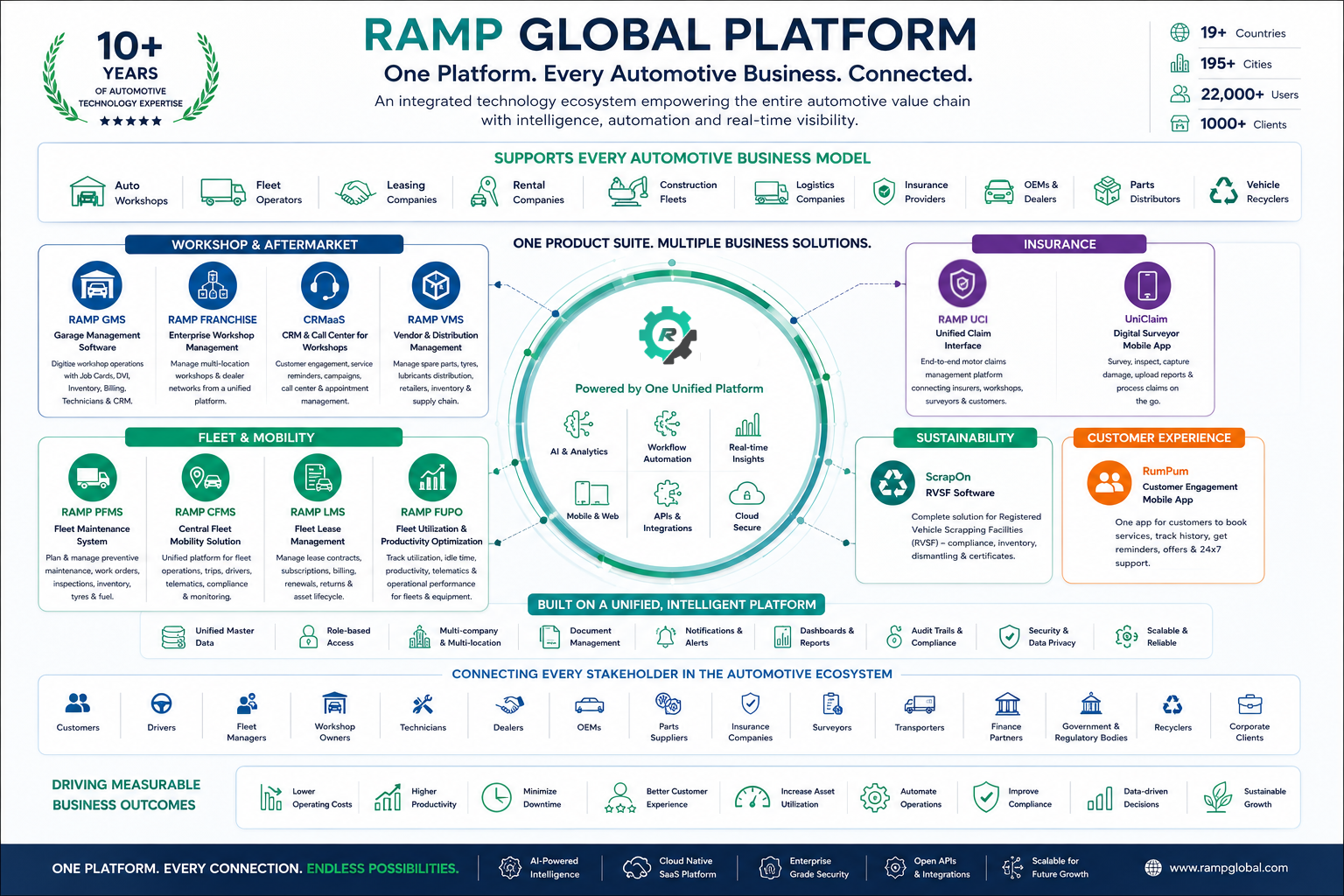
RAMP – ENTERPRISE WORKSHOP NETWORK SOLUTIONS
Standardize Every Process. Govern Every Node. Scale Every Connection.
RAMP is the digital backbone for enterprise service networks and insurance-affiliated workshops. We bridge the gap between individual facility operations and network-level governance — providing the control, visibility, and automation required to manage high-volume, multi-location service ecosystems.
Why Networks Are Different
Managing 5 workshops is not managing 1 workshop × 5
As workshop businesses scale, complexity increases structurally — not linearly.
At network scale, leaders must manage:
- Multiple ownership models (COCO, COFO, FOFO, FOCO)
- Distributed leadership (HQ, regional heads, franchise operators)
- Variations in execution across locations
- Fragmented customer, revenue, and performance data
- Ongoing tension between autonomy and control
Each workshop may perform well independently — yet the network underperforms as a system.
The Core Network Challenge
Location Efficiency ≠ Network Control
Most workshop systems are built for locations. Networks fail in the gaps between them.
Location-Level Efficiency
What traditional systems optimize
- ✓ Job execution
- ✓ Billing
- ✓ Technicians
- ✓ Inventory
Network-Level Control Gaps
What breaks at scale
- ✕ Network-level governance
- ✕ Franchise compliance
- ✕ Standardized execution at scale
- ✕ Unified customer experience
- ✕ Network-wide revenue enablement
The challenge isn't how a workshop runs.
It's how dozens of workshops operate together.
Solution Positioning
What Is an Enterprise Workshop Network (Franchise) Solution?
This is not just workshop software.
It is a network operating architecture that treats the entire workshop ecosystem as one orchestrated system.
Central visibility without micromanagement
Standardization without eliminating local autonomy
Growth without operational complexity
The 5-Layer Network Architecture
How RAMP Orchestrates Workshop Service Networks
RAMP operates as a layered network architecture — allowing workshop networks to scale operations, governance, customer experience, revenue, and intelligence without adding complexity.
Workshop Execution Layer
(Individual Workshop Level)
Standardized service execution at every workshop.
What This Layer Does
The operational foundation of the entire network. Every workshop runs on the same service workflows, ensuring consistent execution and reliable data from day one.
Core Capabilities
- Job cards, inspections & service workflows
- Technician and bay utilization
- Estimates, approvals & billing
- Inventory and parts usage
- Fleet servicing and insurance repair jobs
Outcomes
- ✔ Consistent execution across locations
- ✔ Auditable, compliance-ready operations
- ✔ Trusted operational data at source
HQ & Franchise Governance Layer
(Network Control Without Micromanagement)
Full network visibility with built-in governance.
What This Layer Does
Gives HQ and regional leaders real-time visibility and control — without interfering in day-to-day workshop operations. Governance is enforced through systems, data, and thresholds — not manual supervision.
Core Capabilities
- Performance benchmarking across locations
- SOP and quality compliance tracking
- Franchise performance scoring
- Policy enforcement and approval workflows
- Exception handling and audit trails
Outcomes
- ✔ System-driven governance at scale
- ✔ Consistent standards across the network
- ✔ Local autonomy within defined guardrails
Dependencies
Depends on: Clean, standardized execution from Layer 1
Unified Customer & Partner Experience Layer
(Customers, Fleets & Insurers)
One brand experience across every location.
What This Layer Does
Creates a single digital interface for all external stakeholders — customers, fleet clients, and insurance partners — regardless of which workshop they interact with.
Core Capabilities
- Centralized booking across all locations
- Digital service updates and approvals
- Unified service history (retail + fleet)
- Fleet onboarding and bookings via PFMS
- Insurance job tracking and documentation
- Network-wide loyalty and retention programs
Outcomes
- ✔ Customers experience one unified network
- ✔ Fleets and insurers interact with one system
- ✔ Higher retention, trust, and brand consistency
Network Revenue & Commerce Layer
(Where Scale Becomes Money)
Revenue models that only work at network scale.
What This Layer Does
Converts operational scale into diversified, repeatable revenue streams — coordinated centrally, executed locally.
Revenue Streams Enabled
Revenue opportunities that only workshop networks can scale centrally.
Fleet & Enterprise Maintenance
(via PFMS)
What It Enables
- Centralized fleet onboarding
- SLA-driven servicing across locations
- Network-wide billing and reporting
Insurance Claims & Renewals
(via Insurance Aggregator Partnerships)
What It Enables
- Digital claim settlement workflows
- Insurance repair execution
- Policy selling & renewals
Vehicle Scrappage & Circular Economy
(via Authorized RVSF Partnerships)
What It Enables
- ELV identification & routing
- Digital compliance & tracking
Used Vehicle Sales Enablement
(via Dealer & Marketplace Partnerships)
What It Enables
- Identify sellable vehicles from service data
- Dealer partnership enablement
Verified Parts & Supply Chain
(via Vendor Integration & RVSF Partners)
What It Enables
- Authorized new parts sourcing
- Certified used parts from RVSF partners
- Pricing & traceability control
Outcomes
Networks move beyond service-only income.
Revenue scales with footprint — not headcount.
Built on trust created by Layers 1–3
Network Intelligence & Orchestration Layer
(Leadership & Strategic Control)
Predictive intelligence for network-level decisions.
What This Layer Does
Transforms network data into foresight. This layer continuously analyzes execution, governance, customer, and revenue data to help leadership act early — not react late.
Core Capabilities
- Network health monitoring (operations + revenue)
- Outlier detection across locations, partners, and vendors
- Predictive alerts before SLA, compliance, or revenue risks
- Best-practice propagation across locations
- Expansion readiness and capacity forecasting
Outcomes
- ✔ Predictive, data-driven decision-making
- ✔ Faster issue identification and resolution
- ✔ Compounding advantage as the network grows
Insight
The bigger the network, the smarter it gets.
Governance Model
See Everything. Control Carefully. Empower Always.
Governance is enforced by systems — not people.
Embedded Standards
Standards are built directly into workflows
Alert-Based Control
Deviations trigger alerts, not shutdowns
Threshold-Based Intervention
HQ intervenes only when defined limits are breached
Franchise-First Governance
Franchisees are supported first, penalized last
This creates trust-based governance — not command-and-control oversight.
Network Maturity Alignment
Scale in Phases — Not All at Once
| Network Size | Primary Focus | Activated Layers |
|---|---|---|
| 1–5 Locations | Standardization | Layers 1–2 |
| 5–20 Locations | Visibility & Control | Layers 1–3 |
| 20–50+ Locations | Orchestration & Growth | Layers 1–5 |
No forced complexity.
Only what the network is ready for — when it's ready.
Why This Approach Wins
Workshop Software vs Network Operating System
| Dimension | Traditional Software | WNOS |
|---|---|---|
| Design Lens | Single location | Network ecosystem |
| Visibility | Local | Network-wide |
| Governance | Manual | System-driven |
| Revenue Model | Service only | Multi-stream |
| Scalability | Breaks at 10+ | Built for 50–100+ |
| Franchise Support | Reactive | Proactive |
| Competitive Moat | Low | High |
This is not an upgrade to workshop software — it is a different operating model altogether.
Business Outcomes
What Networks Achieve with WNOS
When workshop networks operate as one system, performance, growth, and valuation fundamentally change.
Operational Predictability
Predictable operations across all locations
Franchise Stability
Stronger franchise compliance and retention
Capital-Efficient Growth
New revenue streams without additional capex
Channel Independence
Reduced dependency on aggregators
Risk-Controlled Expansion
Faster expansion with lower operational risk
Higher Enterprise Valuation
Higher network valuation and investor confidence
These outcomes are structural — not tactical improvements.
Frequently Asked Questions
Common questions about Enterprise Workshop Network (Franchise) Solutions
Common questions we hear from workshop network leaders.
Is this replacing our existing workshop software?
No. It standardizes and orchestrates operations across locations using a network-first architecture.
Will franchisees resist central visibility?
High-performing franchisees welcome it. The system supports — not micromanages.
Can we start small and scale later?
Yes. WNOS activates modularly based on network maturity.
Does this support mixed ownership models?
Yes. It is designed for COCO, COFO, FOFO, and FOCO networks.
Is this only for very large networks?
It's ideal for networks planning to grow beyond 5–10 locations.
Scale Your Network Systematic, Not Heroic
Workshop networks don't fail due to lack of ambition. They struggle when coordination breaks before growth stabilizes. RAMP enabling networks to scale with systematic control.
Control your network transformation today
Precision in Network Operations.